Starzino Bonus Code Smart Usage

In Netherlands, you activate promotions step by step, set limits, and keep your balance and payouts organized.

Play Now!
Slot Fortune Gems 2

Table of contents

  • The Dog House Megaways Slot
  • Lucky Joker 10 Extra Gifts Slot
  • Sword of Ares Slot
  • Floating Dragon Hold & Spin Slot
  • Leprechaun Riches Slot
  • Fruit Coctail Slot
  • The Dog House Megaways Slot
  • Sword of Ares Slot
  • Fruit Million Slot
  • The Dog House Megaways Slot
  • Fruit Box Slot
  • Big Fisherman Slot
  • Seven Books Unlimited Slot
  • Starzino Fortune Slot
  • Sword of Ares Slot
  • Floating Dragon Hold & Spin Slot
  • 9 Mad Hats Slot
  • Floating Dragon Hold & Spin Slot
  • Big Bass Splash Slot

Starzino Bonus For Players In Netherlands

An action sounds simple, but in 2026 it's mainly about timing and clarity: when is something activated, where do you see the status, and what do you still need to do yourself. Think of three moments when players usually "go wrong": depositing too quickly, switching screens in between, or assuming an offer automatically applies without checking. That's why one approach works best: first look, then activate, only then play.

Play Now!
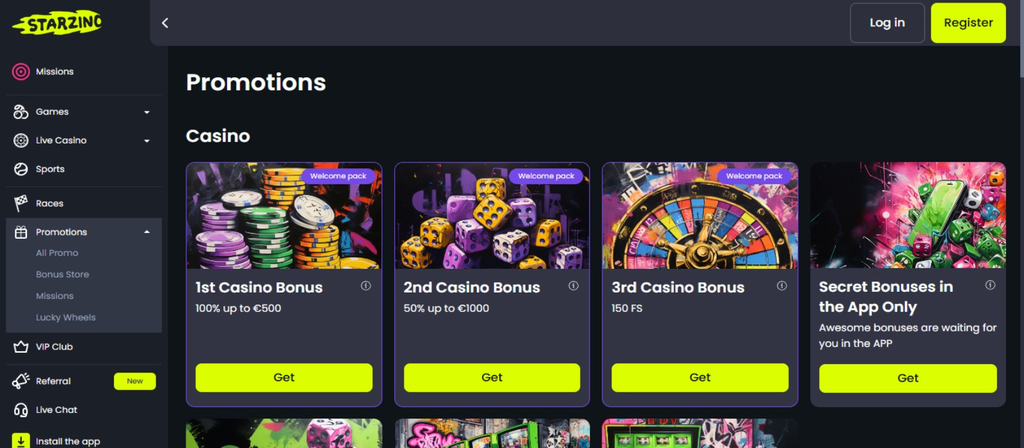
bonus 1

Imagine: you open the app on the train, you have five minutes, and you want to "quickly grab something" before diving into a game. Many players then rush through, only to notice later that there's no confirmation. Take it slower: go to actions or account notifications, look for a clear status (active, pending, completed), and stop if you don't see one.

Important: platform access in Netherlands is intended for adults (18+). Keep it practical and responsible: set limits directly, determine your session duration, and treat a promotion as an extra - not as a reason to speed up your pace.

Starzino Casino Bonus And Promotion Types In 2026

Not every offer works the same way. One is linked to an initial deposit, another comes via a temporary campaign, yet another only appears when you open a specific screen. That's not "secretive", it's simply how modern apps personalize: less noise, more targeted triggers. Your main task is: to recognize which action you have before you, and what the next step is.

Play Now!
bonus 2

Imagine: you see a notification, you click on it, and you expect immediate results in your balance. Often something else happens first: you need to confirm, enter a code, or check a setting before it becomes visible. Therefore, take 30 seconds to scan the main terms: what starts it, what counts, and what is the limit (e.g., betting limit or time limit).

Choose offers that suit your playing style. If you like to test calmly, you'll want a simple action with few rules. If you prefer short sessions, pay extra attention to whether there are no requirements that subconsciously push you towards longer play.

bonus 3

Activating Promotions Without Hassle

Activation is not a trick, it's a process. In practice, it works best if you see it as a mini-checklist: app open, account logged in, action chosen, confirmation visible, only then money or game. If one step is unclear, don't push through. Going back to the overview and checking again is faster than fixing it afterwards.

Play Now!

Imagine: you're tired after work, you want to relax, and you think "I'll sort it out on the way." That's precisely the moment you double-click, skip something, or make a mistake in input. Put one brake on yourself: only activate when you have a stable connection and can calmly check.

Setting Up Account And App For Promotions

Start with the foundation: an easily accessible email, a unique password, and notifications enabled for account confirmations. Many issues around promotions are not caused by the promotion itself, but by expired sessions or missed confirmations. If the app offers extra verification (such as device confirmation), turn it on. It makes retrieval and recovery easier.

Imagine: you switch phones, log in on a new device, and precisely then you want to use an offer. Without proper verification, you lose time on recovery, while you actually just wanted to play. By arranging your security and recovery options beforehand, you prevent that.

Make it clear for yourself too: set your limits right away. Then you won't have to improvise later when you're already in a session.

Enter Code And Check Confirmation

Entering a promo code is often where things go wrong: extra spaces, wrong capitalization, or simply entering it on the wrong screen. Work slowly. Don't blindly paste. It's better to type it neatly once, press confirm, and then check if a clear message appears indicating it has been accepted.

Imagine: you enter a code, you don't get an error message, so you think it's fine. Later you see nothing and get frustrated. Reverse it: if you don't see a confirmation, go back to the action tab or your account notifications, and check the status before proceeding.

Another tip: don't try five variants in a row. Too many attempts can trigger a temporary block. One attempt, check, then the next step.

Read Terms Without Guessing Wrong

You don't have to be a lawyer to understand terms and conditions. You just need to extract the core: what activates the action, what counts, and what limits apply during use. If something feels too complicated, skip it. A benefit you don't understand often becomes a source of stress.

Imagine: you plan to play for 15 minutes, but the action only seems “completed” after many steps. Then it doesn't fit your plan. Choose something simpler, or play without an action - that's often the most sensible choice.

Troubleshooting With Support And Logbook

If something isn't right, don't guess what happened. Gather facts: time, what you did, which screen, and what message you saw. Then check your transaction overview and action status. Only if that doesn't help, is support logical - but with concrete info.

Imagine: you say “it's not working” and you get a standard answer. If you say “after confirmation the status remains unchanged on mobile, around this time, after a deposit”, then someone can think along specifically. Also, remain consistent: do not change account details while an issue is open, that makes it harder to track.

Depositing, Limits And Withdrawing In Netherlands

As soon as money is involved, your pace needs to slow down. Depositing, withdrawing, and limits are linked: you want to know what happens, when it happens, and what you still need to confirm yourself. The fastest route is usually the simplest: one payment method, a clear budget limit, and as few changes as possible during an ongoing process.

Imagine: you deposit quickly because you see an offer, and then you want to withdraw immediately because you're done. Often, extra verification or a “pending” status appears. That's not necessarily bad, but it requires patience. So plan: first get your account in order, only then take actions involving money.

Choosing And Recognizing Payment Methods

Choose a method you understand and can follow. The most important thing is not “the fastest”, but “the most predictable” for your own use. Pay attention to limits, confirmations, and the overview in your bank or wallet history. It's better to start with a small amount to test if everything runs smoothly.

Imagine: you switch methods halfway because something feels slow. Then you lose track, and that makes every status inquiry more difficult. Keep it simple: one method per period, and only change if you have a clear reason to do so.

Subject

What You See In The App

What Players Often Forget

Quick Best Move

Deposit

Confirmation + status

Limit at bank or wallet

First test small

Withdrawal

Status in steps

Profile not yet complete

First check data

Processing

“Pending”

Refreshing too often

Check at fixed times

Limits

Budget and time

Setting limits later

Set before start

Security

Extra confirmation

Notification disabled

Account alerts on

Help

Chat or messages

Explaining too vaguely

Mention time, action, message

Tracking Withdrawals And Understanding Status

Tracking means: watching, noting, waiting. Not clicking repeatedly. If the status remains “pending”, check if an extra step is required (e.g., confirmation or document). Respond fully once, not in separate pieces.

Imagine: you check every two minutes and become impatient. Then you start making adjustments “to help”, and precisely that can trigger new checks. A better approach is to be calm: check at fixed times, and don't change anything while the request is in progress.

Budget, Time And Responsible Play

An action is never a reason to stretch your budget. Set limits for deposits and session time, and stick to them. If you notice you're playing to push away frustration or “get something back”, that's a signal to pause.

Imagine this: you tell yourself 'just five more minutes' and you repeat it three times. That's the moment for a timeout. Close the app, activate a pause if that option exists, and come back later with a clear plan - or stop completely if it feels better.

Choosing Games And Using The App Efficiently

Efficient mobile usage primarily means: fewer clicks, more overview. In 2026, catalogs are large, and precisely for that reason, it helps to limit choices. Choose a few games per session, keep your stakes stable, and check your limits before you start. This way, a session remains relaxing instead of chaotic.

Imagine this: you scroll endlessly, you start three games, and you forget why you opened the app. Make it concrete: 'I'm testing 2 games, for 15 minutes, with a fixed stake.' After that, you close the app, regardless of the outcome.

Quick Navigation With Filters And Favorites

Use filters to choose faster: theme, volatility, or stake level. Pin your favorites, so you don't have to search again every time. That sounds minor, but it prevents impulsive choices when you are actually tired or distracted.

Imagine this: you open the app late in the evening, you click the first thing that glitters, and you lose control over your rhythm. Favorites and filters give you a 'fixed route' - you choose more consciously and stop more easily.

Notifications, Security And Permissions

Notifications are useful if you keep them smart: account confirmations, transaction updates, and time alerts. Don't turn everything on, but don't turn everything off either. The goal is that you don't miss important signals.

Imagine this: you don't receive confirmation of an action because notifications are off. You then end up taking double action and making things messy. With basic alerts on, you remain calm: you see what's happening, and you don't have to guess.

Properly Ending Sessions On Mobile

Mobile gaming has one pitfall: you don't truly log out. You put the phone away, the app remains open, and later you 'just continue' without a plan. Make logging out a ritual: check your balance overview, briefly review transaction history, and end the session.

Imagine this: you're using a shared device or leaving your phone unattended. In that case, you don't want an open session. A proper logout isn't a formality; it's protection.

Practically Applying Timeout And Self-Exclusion

Timeout is for when you notice you're no longer choosing, but reacting. Self-exclusion is for when you truly need distance. Both are tools, not a label. Use them if you notice that limits aren't enough.

Imagine this: you open the app automatically, without pleasure, just out of habit. Then a break is exactly what you need. Set the timer, put the phone away, and plan something else. That makes playing a choice again, not a reflex.

Practical Routine For Actions In 2026

The best routine is boring, and that's why it works. You first check your limits, you only activate what you understand, you play within your plan, and you properly log out. In 2026, that's the difference between 'just a bit of fun' and 'what am I doing'.

Imagine this: you want one short session, but you get drawn in by notifications and variations. With a routine, you prevent that: you take the same steps every time, and you leave the rest alone.

Short Checklist For Every New Session

Start with three questions: how much time do I have, what is my budget, and what is my goal (testing, relaxing, or stopping after a fixed limit)? Then set your limits and choose a maximum of two or three games. If you want to use a promotion, first check its status and confirmation, and only proceed when everything is clear.

Imagine this: you start without a plan and get irritated after a few rounds. That's the point where people make bad choices. A checklist prevents that, because you decide beforehand when to stop. Afterwards, log out: check your overview, possibly note what you've learned (e.g., which game suits you), and disengage. That makes the next session calmer and more conscious.

FAQ

First open the account or promotions tab and look for a status or notification indicating what is active, instead of going straight to games. Imagine you only have five minutes: it's better to get an overview first and only then start playing. If you see nothing, log in again and check if notifications for account updates are enabled, so confirmations don't disappear.

Stop repeating and check the promotions screen, your account notifications, and the overview of recent actions. Imagine the app just refreshed due to a weak connection: it might seem like nothing is happening, while the status still needs to update. Wait briefly, re-check, and only then take one targeted step, such as going back to the promotions tab.

Because it's best to choose limits when you are calm, not in the middle of a session. Imagine you're tired and still 'just keep going': without a limit, you can easily go beyond your own plan. With a deposit and time limit, you keep the session predictable and prevent impulsive decisions.

Check the status at fixed times, note the time, and don't change anything in your account while the request is pending. Imagine you keep refreshing and getting impatient: you'll start tinkering with settings and inadvertently create extra checks. Calmness and consistency usually make the process faster and clearer.

As soon as you notice you're playing out of frustration, habit, or to 'get something back'. Imagine you open the app automatically without really wanting to: that's precisely the signal that a break helps. A timeout is a short brake; a longer break or self-exclusion is appropriate if you notice you need more distance to regain control.

Mention the time, exactly what you did, on which screen, and what notification you saw, plus your device type. Imagine you just say 'it's not working': you'll get a standard list. With concrete details, support can think along specifically, and you won't have to talk back and forth endlessly.

Work with a fixed session duration, activate a time alert, and consciously close the app afterwards. Imagine you put your phone away with the app open: you'll later 'just continue' without a plan. A proper logout and a clear stop rule make the difference between relaxation and aimless continued play.

Play Now